Pizza, drones and a strange night in Frankfurt
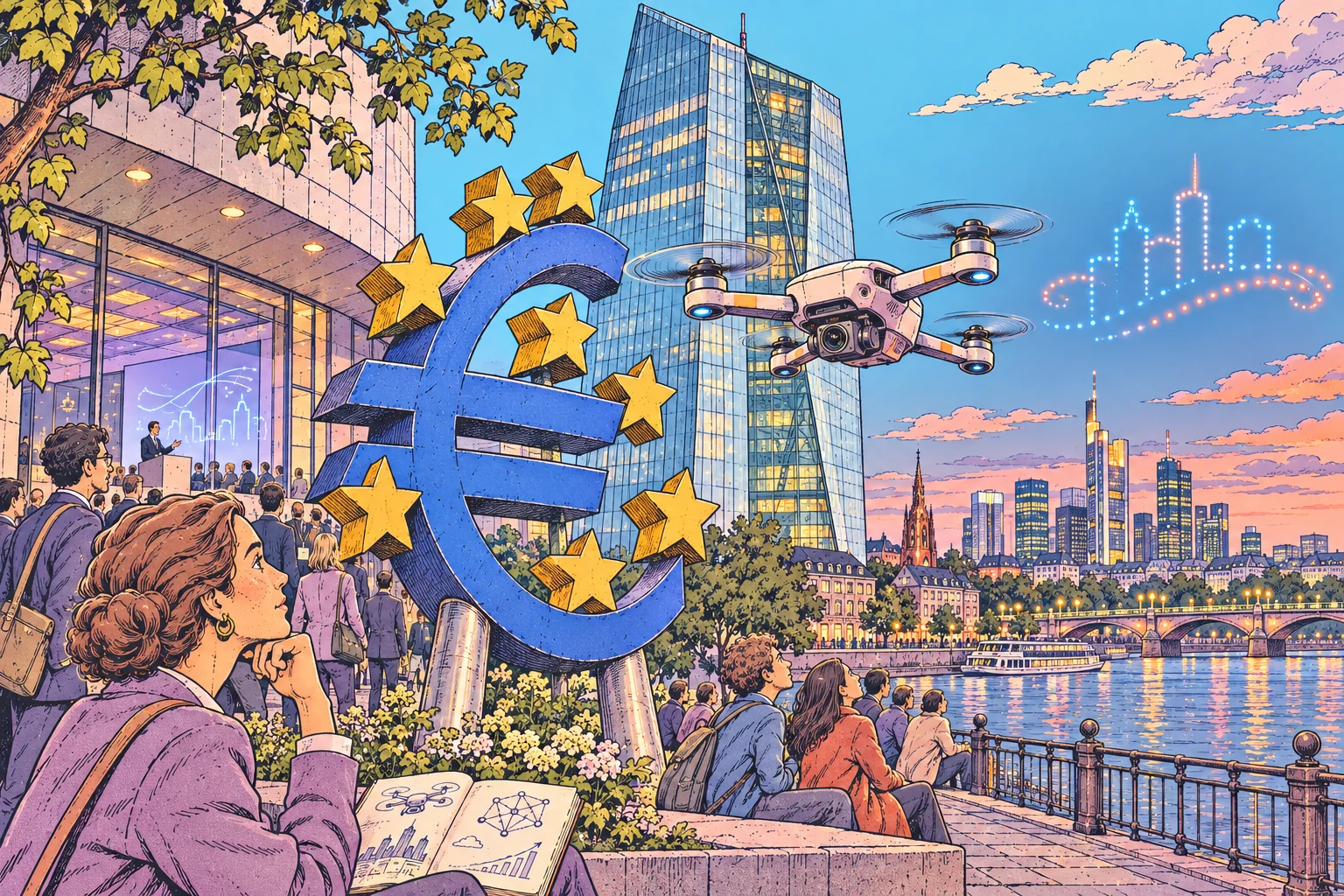
Eight years later, I keep returning to a few scenes from Frankfurt: a pizza, a friend I had no reason to expect there, lights moving together above the river, and a room full of people struggling to imagine where drones might take us. They belong to the same visit. The connections between them have become more interesting with time.
In September 2018, I was travelling regularly between Rome and Frankfurt. We had opened an INNAAS office there, and I was part of Accelerator Frankfurt. Lufthansa flights, cold air, work, another flight. On this particular visit I was speaking at the European Central Bank about AI and querying data in natural language. I have written separately about that day, including the jacket and tie and the hostel room I shared with twelve other people.
This memory begins with dinner.
I had found Montana, a pizzeria in Frankfurt, and went there for a pizza. Away from home, discovering a good local pizzeria is a small logistical victory. During that visit, I also ran into an old friend from Philip Morris International, where I used to work. In a city I was trying to make familiar, someone from a previous part of my life suddenly appeared.

Those encounters have an odd effect on me. For a moment, the different periods of your life occupy the same place. The work you used to do, the people you knew, the company you are now building. All the planning that gets you onto a flight, and the evening still manages to surprise you.
Then there is the river.
I remember seeing a coordinated drone show over the Main. It was the first time I had seen anything like it in person. The skyline was already full of lights; above it, another set of lights was moving with a shared purpose. I took a photograph. The time on it is 21:16.
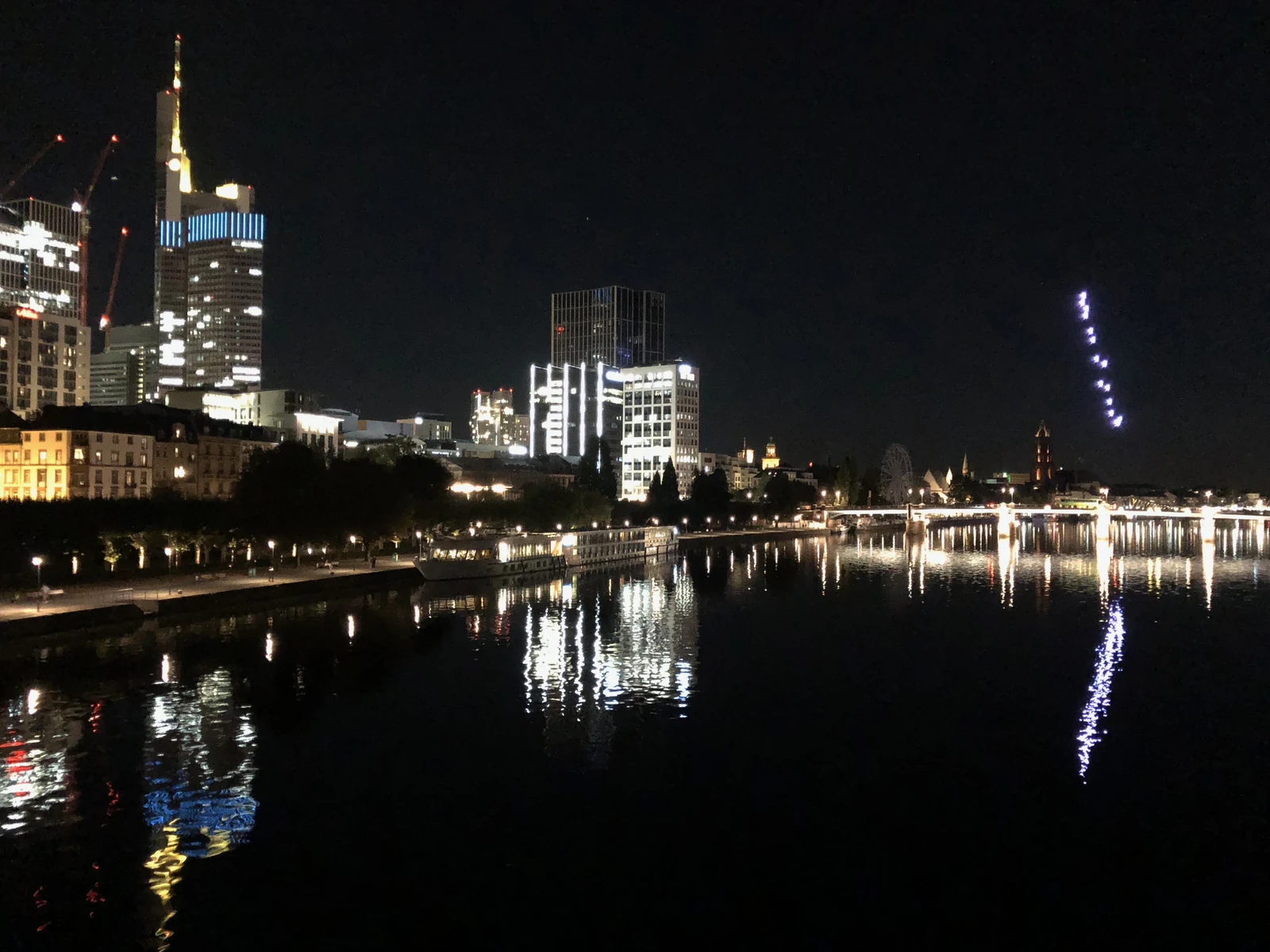
Frankfurt, September 2018. The lights on the right are what stopped me by the river.
I was working with AI every day, but there was something particularly compelling about seeing coordinated behaviour in physical space. You could watch the result directly. The movement was out there over the water, with the city continuing beneath it.
The other scene is from the ECB event. A participant showed a hypothetical video of autonomous drones capable of killing people. I remember the discomfort in the room, and a reaction that seemed to put the scenario somewhere far outside reality. It felt as though people wanted to push it away before considering it.
That reaction stayed with me more than the details of the film. I cannot reconstruct everybody's opinion from a room's atmosphere. What I remember is my own frustration: the possibility deserved serious attention, even if the particular scenario was speculative.
The river and the conference room sit very close together in my memory. In one setting, coordinated flying machines were a spectacle. In the other, a darker application seemed almost impossible to contemplate. I found the difference in our willingness to imagine them unsettling.
What became harder to dismiss
After Russia's full-scale invasion of Ukraine in 2022, drones became a constant presence in accounts of the war. By April of that year, CNA was describing extensive use of both commercial and military drones, including their role in surveillance. That brought the memory of the Frankfurt screening back to me.
A drone can be remotely piloted. It can navigate automatically. A system can also make decisions about selecting and engaging a target. These are different capabilities, with very different implications. The ICRC's 2021 position on autonomous weapons focuses on systems that select and apply force without human intervention. The presence of drones in a war, by itself, establishes none of those particular decisions as autonomous.
The question that troubles me is how readily we confuse an unwelcome possibility with an implausible one. A frightening demonstration can be exaggerated and still raise a problem worth taking seriously. Dismissing the whole thing is comfortable. Examining which parts are feasible, which remain difficult, and what would make adoption accelerate requires much more work.
I see a quieter version of this in business. People can recognise a technical advance and still resist following it through to its consequences. They accept the demonstration. Then they return to plans that assume the surrounding world will remain much the same. The uncomfortable part is often the change it would require of them.
Working on AI makes that an easy criticism to direct at other people. I try to turn it back on myself. Which developments am I taking seriously only because I like them? Which am I dismissing because I dislike the world they suggest? Enthusiasm and discomfort can both distort a forecast.
I would not have predicted, standing by the Main in 2018, the precise course of the years that followed. What I had in front of me was enough to ask better questions. Machines were becoming cheaper, more capable and more coordinated. The purposes people found for them would matter enormously.
The photograph remains a photograph of a beautiful evening. I like that it has kept the ordinary details around the memory: a pizza, a familiar face, a walk by the river during a working trip. I had gone to Frankfurt to explain what we were building. Some of what I remember most clearly happened after I put the presentation away.
The other part of the visit: speaking at the ECB · Making the physical world programmable