Making the Physical World Programmable
By Simone Di Somma, Co-founder and CEO
Software has eaten the world. Now it must pilot it.
AI models can help write code, interpret instructions and plan tasks. Applying those capabilities to a warehouse, factory or inspection site introduces a different set of problems: sensing the environment, controlling equipment, and recovering safely when something goes wrong.
Today's autonomous systems exist in silos. One vendor's robot speaks a different language than another's. Legacy PLCs don't talk to modern vision systems. Simulation environments are toys compared to the messy reality of factory floors, ports, and energy sites.
Developers want to move machines with the same confidence they deploy web services. Operators need mixed fleets to work together without vendor lock-in. Safety teams demand visibility and override controls that respond in milliseconds, not minutes.
What We're Building
Cyberwave is an AI-native orchestration platform for the physical world. We connect heterogeneous machines, mirror them faithfully in simulation, and coordinate their behaviors at scale.
Here's what that means in practice:
- Connect anything: If it moves, senses, or acts, we speak its language. Open formats. Real interfaces. No proprietary hostages.
- Twin everything: Use simulation as a staging environment, with software-in-the-loop and hardware-in-the-loop tests before deployment.
- Program behaviors: Tasks like "inspect aisle seven" or "pick SKU 431" become small, testable units you can version, compose, and reason about. Developer-first. Git-friendly. Rollback-ready.
- Orchestrate fleets: Schedule and supervise across mixed vendors and environments — labs, factories, ports, warehouses, vessels. Mixed fleets are a basic design requirement.
- Deploy safely: Policies, guardrails, and observability as first-class citizens. Human override is sacred and fast. AI modules run inside deterministic contracts with explicit failure modes. If we can't see it, we don't ship it.
Models are opening up new ways to express physical tasks. Reliable execution still depends on the systems around them: simulation, interfaces to hardware, monitoring and controls.
Simulation lets developers test behaviours before putting them on hardware. Version control, reproducible builds and rollback are useful disciplines in robotics too, alongside physical testing.
Our Commitments
- Time to value: Minutes to demo. Days to pilot. Weeks to production.
- Openness: Your assets. Your data. Your logs. Always.
- Safety by default: Build safety controls into the system from the start.
- Boring is beautiful: We choose a quiet robot that never hurts anyone over a flashy demo that cuts corners. Every single time.
- Reality over slides: We ship small. We ship weekly. We let the field teach us what matters.
We are building for several kinds of operators:
- Manufacturing operators who need flexible cells and faster inspection without six-month integrations.
- Logistics leaders orchestrating mixed fleets across complex environments without getting locked into a single vendor's ecosystem.
- Energy and maritime teams to inspect, monitor and perform duties where we don't just save money, we save lives.
- Defense and public-safety missions where audit trails, policy enforcement, and recovery aren't nice-to-haves.
If you've ever looked at a heterogeneous fleet and thought "this should be programmable," this is for you.
Who We Are
I’m Simone Di Somma. I built Askdata, which was acquired by SAP. Taking that product from an early demonstration to enterprise use taught me how much work sits between a promising idea and a dependable system.
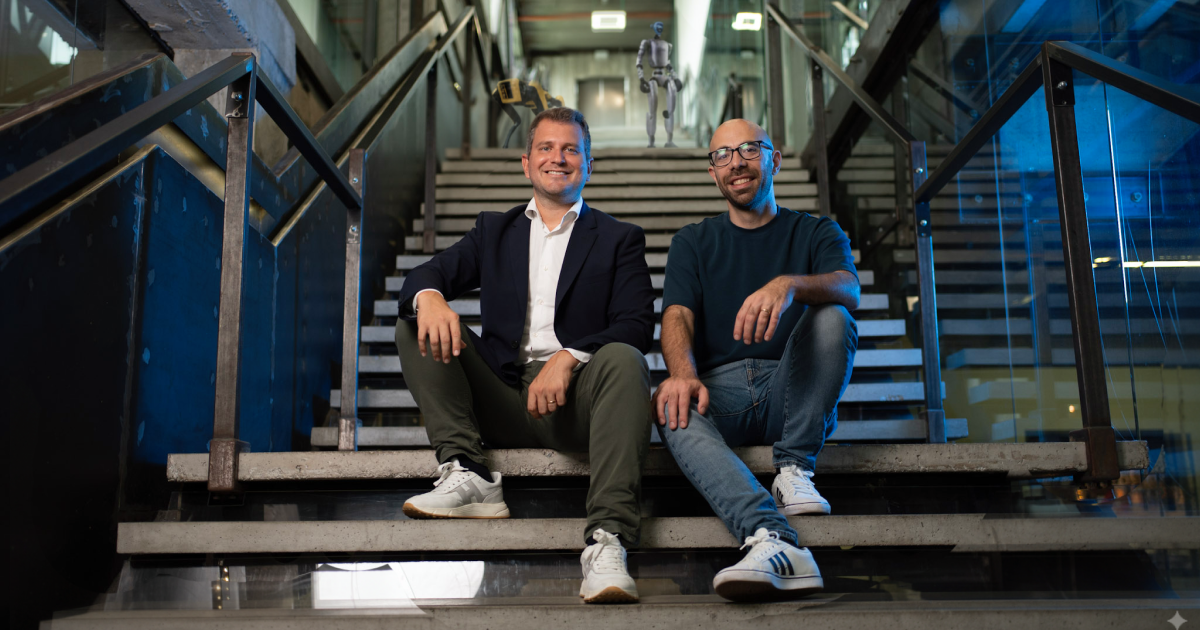
With me is Vittorio Banfi, a founder and former Google employee whom I first met in San Francisco years ago. We share an interest in making it easier for teams to turn prototypes into systems they can depend on.
We’re building from Milan — our ground truth and Europe’s workshop. Europe is in a rare window: reindustrializing with autonomy, hardening supply chains, and marrying sustainability mandates with productivity. Milan sits where manufacturing excellence meets tough engineering and design that serves work, within reach of the continent’s most demanding factories. It keeps us shoulder-to-shoulder with machine builders, system integrators, and operators who stress-test Cyberwave under the only metrics that matter — cost, safety, and uptime.
From day one we run operations in Zurich and San Francisco. Zurich brings robotics precision and a deep hardware culture; San Francisco brings AI velocity and global ambitions. We need all these souls.
What Comes Next
We're expanding our asset catalog. Hardening safety policies. Publishing reusable behaviors that compress the path from idea to field. Deepening simulation tooling. Opening the platform to third-party skills.
Every deployment feeds telemetry back into the product. Every incident makes the next release safer. Every hour of autonomy teaches us something new.
Progress is uneven. Hardware breaks. Supply chains slip. Funding cycles turn cold. Markets wobble.
In those moments, we'll remember why we started: to make the physical world programmable, safely.
We will keep the scope manageable, learn from deployments, and spend time on the problems that affect reliability.
For developers ready to move machines with code, for robotics and hardware makers who want vendor-agnostic integration, and for operators seeking safer, faster autonomy — we’re ready to work.
If you have a device mix or an operational problem you would like to work through, we would like to hear about it. We can start in simulation and then test on site.