Great Mazinger was always my favourite
I took a selfie with Mazinger Z in a shopping centre. He has his usual serious expression. You can see how pleased I am. My favourite, for the record, was Great Mazinger. Apparently I still care enough to make the distinction.
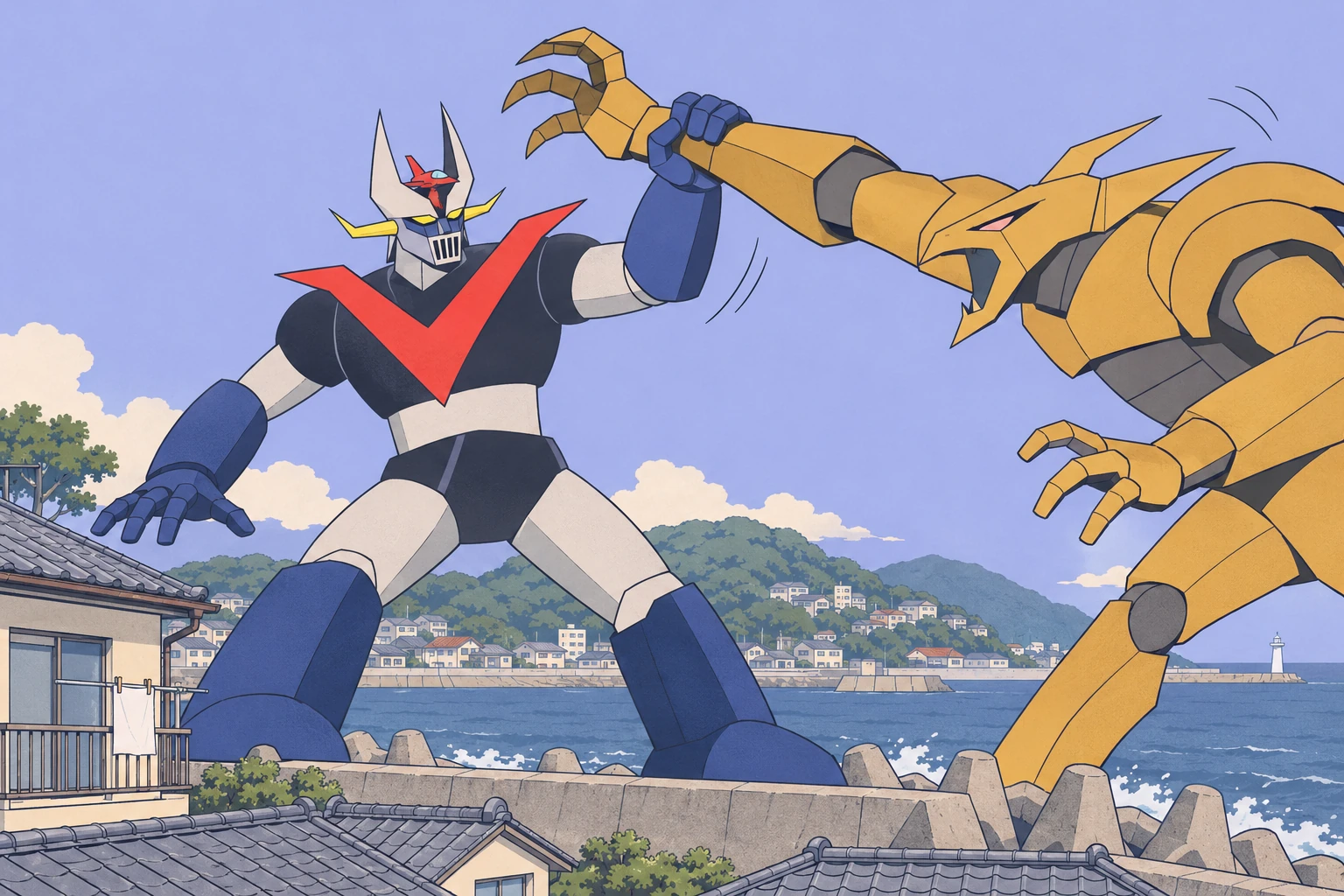
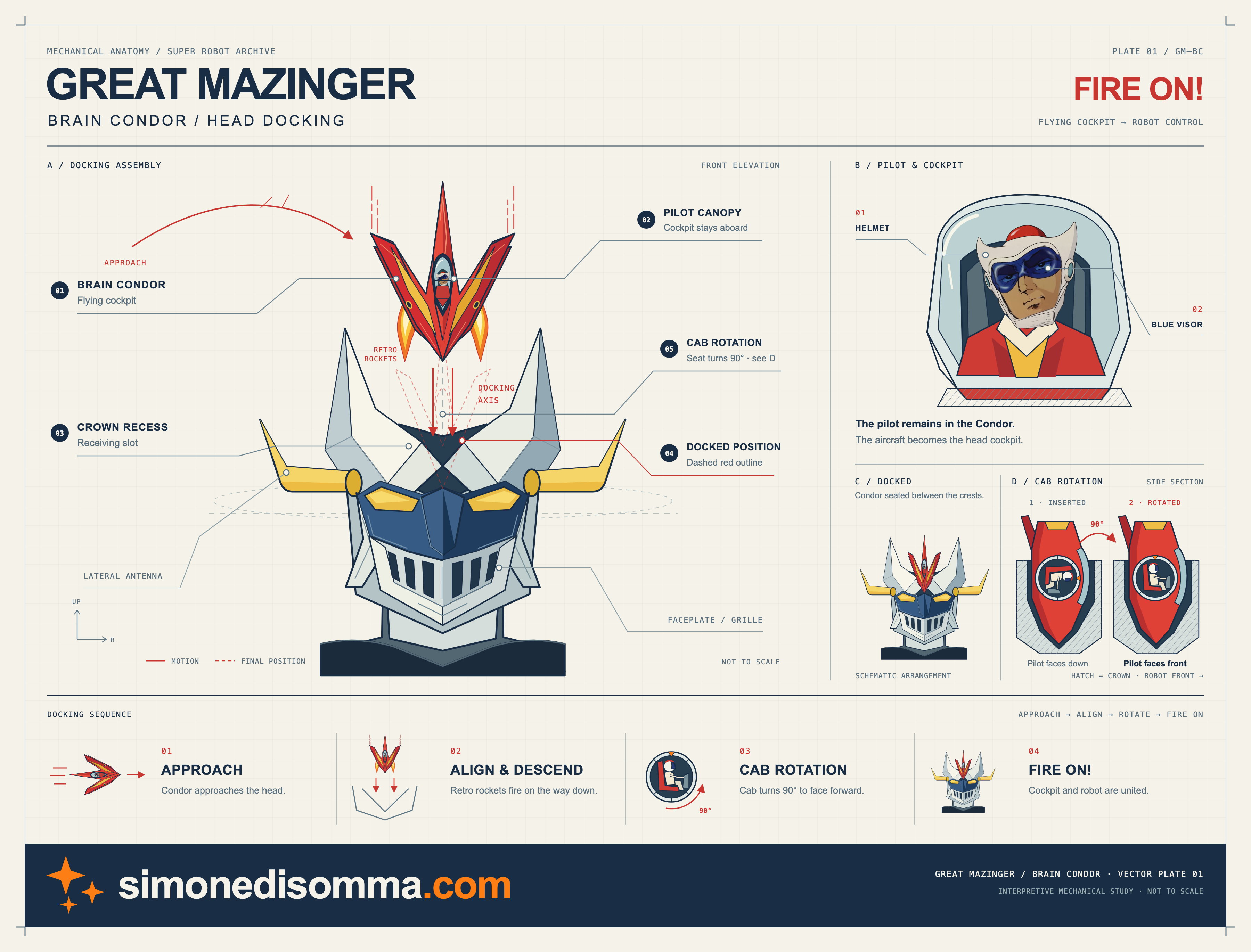
As a kid, I used to wait for Tetsuya Tsurugi’s little red aircraft to dock in the robot’s head. I loved that sudden change of scale. One moment a man was flying a plane. A second later he could throw a punch level with a fifth-floor window. Gō Nagai and Dynamic Pro put the pilot right there in the giant’s forehead. However far the camera pulled back, I knew where to look for him. Great Mazinger credits
The Japanese robot cartoons I grew up watching in Italy had all sorts of ideas about where the human being belonged. I only learnt the word mecha later. In Steel Jeeg, which Nagai created with Tatsuya Yasuda and Dynamic Pro, Hiroshi became the head. He could be as brave as he liked, but until Miwa flew in with the Big Shooter and launched the parts he needed, he had no arms. As a boy I wanted to be Hiroshi. These days, when I think of all the times I’ve needed someone to turn up with the part I was missing, I have a soft spot for Miwa. Steel Jeeg credits
What I loved about Daitarn 3, created by Yoshiyuki Tomino and Hajime Yatate and directed by Tomino, was Banjo Haran’s cheek. He had the sun itself for a weapon and still felt the occasion called for a little showmanship. Then there was the Italian theme song by I Micronauti. A few bars in and I wanted to join the chorus. Even the lesser-known shows on local TV had tunes like that. I’ve forgotten some of their titles, but play me the opening bars and I still know exactly when to start singing. I’d be on my feet before the fight had even started. Daitarn 3 credits · Italian theme song
I liked knowing who to root for. A monster appeared, there were houses down below, and Tetsuya went out to meet it. As a child I could tell good from evil in that scene. I only had to imagine what would happen to the people in those houses if Mazinger stayed at the base. Growing up, I learnt to be wary of anyone too quick to cast himself as the good guy. I still have little patience for the idea that if you think about something long enough, it all turns grey. When someone needs a hand and you can help, you generally know the right thing to do. The hard part is getting up to do it.
Then came Hideaki Anno’s Neon Genesis Evangelion. I’d spent years waiting for the pilot to climb aboard. With Shinji, for the first time, I wanted the adults to let the kid go home. In the first episode he’s frightened and refuses to pilot the Eva. Then they bring Rei in on a stretcher. If he walks away, she goes in his place. He gets in, still scared. That detail means more to me the older I get. I can be angry with his father for putting him in that position and still see the good in what Shinji does for Rei. Neon Genesis Evangelion
I work with robots now. A mechanical arm can hold a load that would break a person’s back. It can also do real harm if the person at the controls is in a hurry. That’s one way a robot amplifies us. Both our care and our carelessness have a greater reach. I believe in virtue, and I want it to win. On an ordinary working day, it might look like someone stopping a machine and waiting for a colleague to get their hand clear.
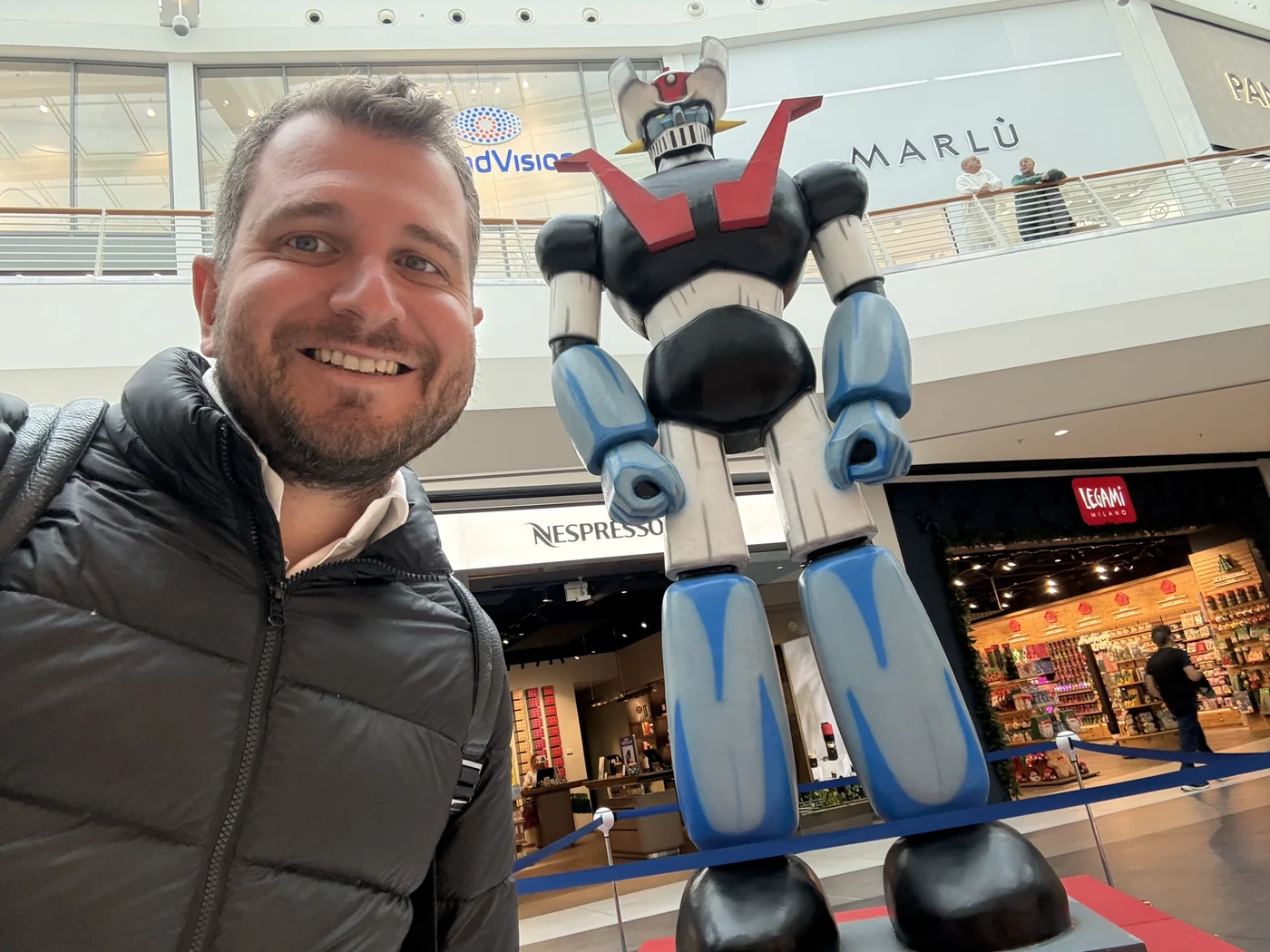
Looking at that photo, I try to imagine explaining all this to the boy I was. He’d probably have let me finish. Then he’d have asked, “Was Great Mazinger there too?”